

Australia has been told that the only way to save the planet is to carpet the countryside with solar panels and wind farms, string thousands of kilometres of high-voltage wires across forests and farmland and build vast batteries in the hope they’ll store enough power to run a modern economy. We are told this is urgent, that it is moral, that it is the only way.
But step back for a moment. On the world’s current trajectory, if Australia reached net zero by 2050, the effect on global temperatures would be measured in a few thousandths of a degree. Almost unnoticeable! That’s not opinion, that’s arithmetic. Our sacrifice, no matter how painful, will have a negligible impact on the climate, yet we are acting as though bulldozing forests, scarring the countryside, repurposing good farmland and pushing up power bills is a noble crusade. It is not. It is folly.
The Damage We Pretend Not to See
Take Victoria’s wind rollout. The Western Victorian Transmission Project proposes 190 kilometres of new transmission lines slicing through prime farmland, cutting across communities, and devaluing properties — all to service a scattering of wind farms. Farmers have protested for years, warning of loss of arable land, bushfire risk, and visual blight, but the project rolls on.
Or look at New South Wales, where the Central-West Orana Renewable Energy Zone is turning productive farmland into an industrial zone. Locals are watching sheep country disappear under solar panels, while the promised “regional benefits” often amount to a handful of temporary jobs and an eyesore that lasts decades.
Tasmania, once the “clean, green” state, is facing the massive Marinus Link project to export power to the mainland. This means tearing up wilderness and farming country to build 240 kilometres of overhead lines for a scheme that many experts say is uneconomic and unnecessary.
All the while, we are felling old forests in places like Victoria’s Latrobe Valley to make way for “green” infrastructure while sacrificing habitats that can never be replaced. Forests that took centuries to grow are bulldozed in weeks for technology that will need replacing in 20 years.
The Silliness of “Renewables + Batteries Only”
Even if we accept this damage, the numbers don’t add up. South Australia has more wind and solar per capita than anywhere in the world, yet it relies on gas to keep the lights on when the wind dies and the sun sets. The much-touted Hornsdale “Big Battery” near Jamestown can power the state for just a few minutes — not hours, not days. The new Waratah Super Battery in New South Wales is designed to keep Sydney stable for only 20–30 minutes in an emergency. Is this really the backbone of a modern industrial economy?
To replace baseload coal and gas entirely with renewables and batteries would require land on a staggering scale, constant mining of rare earths and lithium, and replacement of hardware every 20 years. That means we’re not just paving over farmland once, we’re committing to do it again and again, forever.
For what? To shave a minuscule fraction of a degree off global warming, while China, India and others continue to expand coal power at a scale that dwarfs our entire grid?
A Smarter Way Forward
This is not an argument for inaction. It is an argument for sanity. A “Go Gently” pathway means cutting emissions in a way that preserves what matters: food security, forests, habitats, and industry.
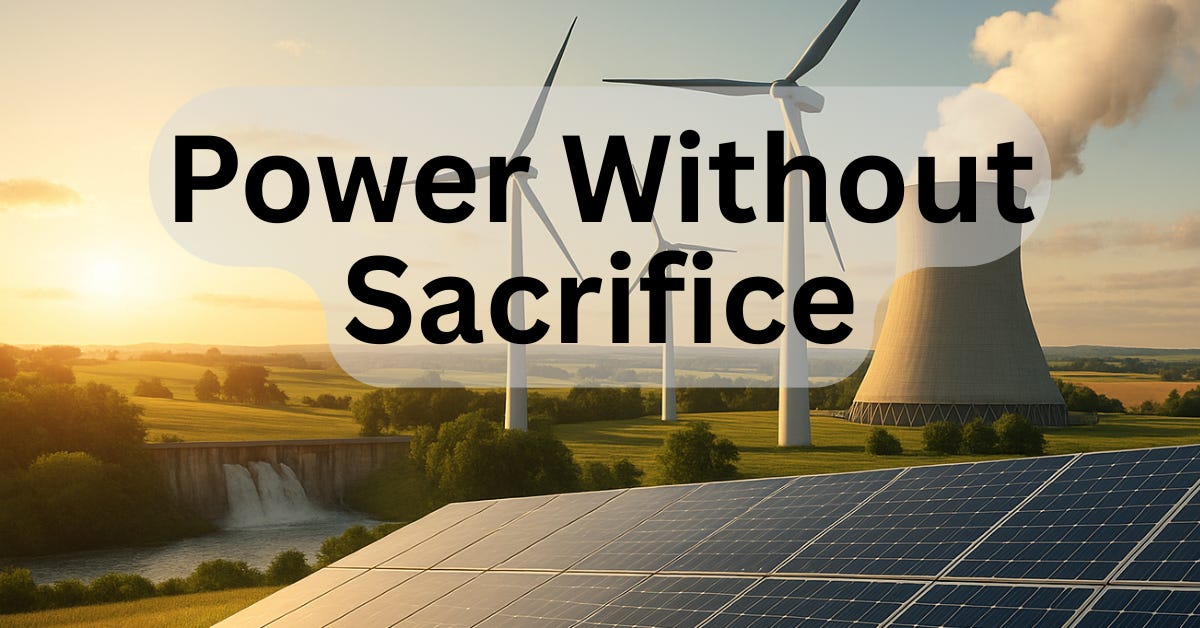
That means a balanced energy mix — renewables where they make sense, but supported by firm, low-emission power such as nuclear and hydro. It means using rooftops, carparks and brownfields before we touch productive farmland. It means co-locating power lines along existing transport corridors where possible instead of carving new scars across the landscape.
It also means broadening the focus. Our seas absorb about a quarter of all human carbon emissions and soak up around 90% of the excess heat. Without this, the “1.5 degrees” everyone chants about would be closer to 3.5 by now. The seas are now choking with plastics and waste, but ignored during our obsession over carbon. Our forests, which absorb and store vast amounts of carbon dioxide (CO2) from the atmosphere are bulldozed, sacrificed for “green” infrastructure. Climate matters, but it is not the only thing that matters.
The Futility of Needless Sacrifice
Australia’s leaders have convinced themselves that wrecking the countryside in the name of net zero is an act of moral virtue. But what virtue is there in destroying forests to save the climate? What sense is there in covering sheep paddocks with panels while China builds another coal plant every two weeks?
We should lead by showing how to cut emissions without destroying the very environment we claim to be saving. Net zero should be the destination, but the path matters and the path we’re on is not only unsustainable, it is absurd.
It’s time to go gently: steady, sensible, and balanced. Protect the climate, yes, but also protect our food, our forests, our wildlife, our economy. Commonsense needs to reign.
We need an energy system that works for everyone — the environment, the country, industry and the people. Renewables with batteries alone can’t carry the load, especially for heavy industry. A truly reliable, emissions-free grid requires a balanced mix: renewables and batteries, backed by firm nuclear and hydro.