

Part 3 of 3 — The Unmaking of a Nation Series
We’ve seen what happens when a country stops making things and how our dependence on foreign chips has left us exposed. Beneath both problems lies something even more fundamental: energy.
Every act of making, whether it’s smelting aluminium, producing fertiliser or manufacturing chips, begins with power. Energy is the bloodstream of industry. Without it, nothing works.
Australia has no shortage of resources. What we lack is affordable, reliable energy to turn them into value. We dig the coal, extract the gas, harness the sun and wind — then pay some of the highest industrial power prices in the developed world.
Factories don’t run on promises. They run on kilowatts.
The Energy Squeeze
For two decades, energy policy has swung between ideology and indecision. Coal plants were allowed to age without successors, gas exports were prioritised over domestic supply, and renewables were rolled out faster than firming capacity could follow.
The result is a grid that’s greener on paper but costlier and less dependable in practice. When the wind drops or clouds linger, we fall back on gas bought at global prices. When demand surges, prices spike. Smelters, glassworks and chemical plants can’t plan production around the weather, so many have scaled back or shut down.
Manufacturing needs certainty. Without it, investment goes elsewhere — to nations with cheaper, firmer power.
The Limits of “Cheap” Renewables
We’re told renewables are the cheapest energy source and on the generation side, that’s mostly true. But the real cost isn’t in the sunlight or the breeze, it’s in making them reliable.
Each turbine, panel and battery must be connected by thousands of kilometres of transmission lines, almost all built with imported materials. The infrastructure costs alone are driving up prices.
No one disputes the need to cut emissions. The question is whether we can do it without crippling the industries that keep the country afloat.
The Missing Middle
The debate has become polarised: coal versus renewables, as if the only choices are the past or a fantasy future. The truth sits between.
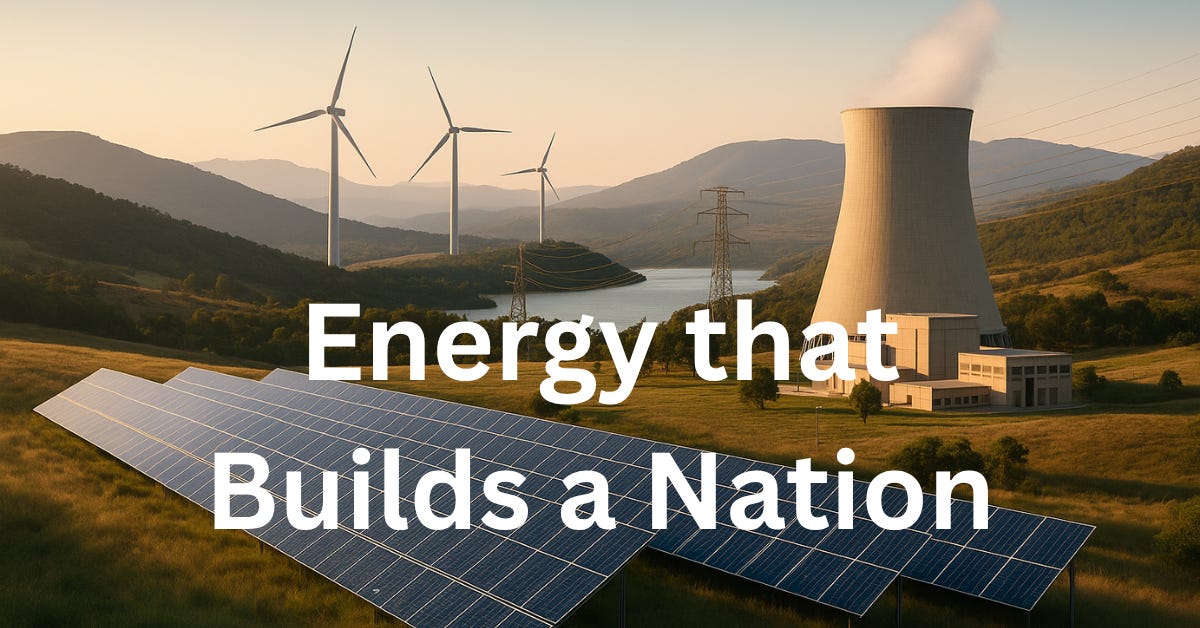
A resilient grid needs balance — renewables for sustainability, gas and hydro for flexibility, and firm, zero-emission power to hold everything steady. That anchor could be nuclear, if we were willing to talk about it rationally.
Anyone serious about energy knows the word dunkelflaute — the dark lull when there’s little wind and no sun for days. Europe plans for it, yet we act as if it can’t happen here. But southern Australia experiences its own version every winter: calm, overcast spells lasting three or four days, when renewable output plunges just as heating and industrial demand rise.
Batteries can steady the grid for hours, not days. No fleet in the world can fill a multi-day gap. That’s why every advanced economy pairs renewables with firm generation — hydro, gas or nuclear. Without them, the lights don’t stay on.
The World Moves On
Across the globe, nations are acting on that reality. Canada, France, the United States, the United Kingdom, Sweden, Finland, Japan, South Korea, China and India are all expanding or reviving nuclear programs. Even smaller nations like Slovakia are investing in next-generation reactors.
Many see nuclear not as a relic, but as the clean, firm backbone of an industrial future.
By contrast, Australia remains one of the few countries on earth where nuclear power is banned by law. Why are we still the outlier?
Over an 80-year horizon — the lifespan of a modern reactor — every major study tells the same story. When you count the cost of storage, transmission, rebuilds and backup, a mixed grid of renewables, nuclear and limited storage is more reliable and, over time, cheaper than a 100 per cent renewables system.
CSIRO’s GenCost reports, AEMO’s integrated modelling and international data from France and Canada all show it: renewables alone require massive overbuild and endless storage; a mixed system keeps power firm without runaway cost.
The Price of Inaction
If we keep treating energy as a political trophy, we’ll keep paying for it like one. High prices will keep hollowing out industry, pushing jobs and emissions overseas.
The irony is stark: we’ll end up importing the very goods we once made along with the carbon we thought we’d avoided. That’s not progress; it’s displacement.
A nation that loses its manufacturing loses its balance. Without affordable, firm energy, there is no revival — only rhetoric.
The Way Forward
Australia could build an energy system that’s both clean and strong.
Use renewables where they work best — solar and wind supported by short-term batteries.
Rely on firm generation — nuclear and hydro — to carry the load through calm, overcast periods.
Keep gas as a transitional safeguard until firm, zero-emission power is fully established.
Plan transmission where it’s needed, considering natural habitats, farming and forests, not just to satisfy political optics..
Tie every energy decision to what it enables — steel, fertiliser, glass, chips — the industries that sustain us.
We have the minerals, the engineers and the sunlight. What’s missing is courage, leadership and a plan that treats energy as infrastructure — the foundation on which every factory, farm and future depends.
Reclaiming Industrial Power
If we want to rebuild what we’ve lost, we must think like builders again — not just consumers of technology, but creators of it.
Energy is where it begins. Affordable, abundant power turns resources into industry and industry into independence.
In the end, power isn’t just what flows through the wires.
It’s the capacity to create, to build, to stand on our own.
That’s the power Australia needs to find again.