

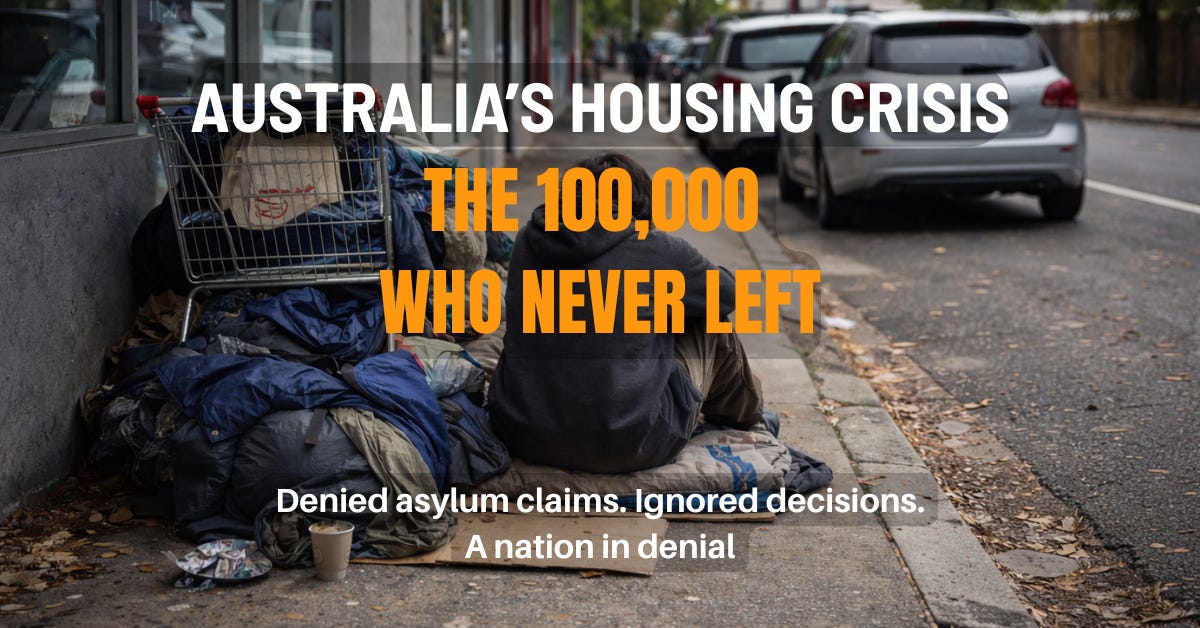
Australia did not set out to keep more than 100,000 people in the country after their asylum claims were denied. That is where we have ended up anyway. Not through policy, not through principle but through drift, hesitation and a government that no longer seems willing to enforce its own decisions.
For years this sat quietly in the background. Then the housing crisis exposed it.
The housing crisis is no longer something you read about. It is something you see. It is people sleeping on footpaths. It is families with children living in cars. It is workers finishing a shift and then bedding down wherever they can because there is nowhere else to go. This is not a distant problem. It is happening in our suburbs, outside our shops and in places that used to feel stable and predictable.
There is something deeply confronting about that. Not just the hardship but the humiliation. The quiet, grinding humiliation of a country that can no longer provide the most basic security to its own people while insisting everything is under control.
Yet we are told none of this has anything to do with migration.
We are told the problem is “complex”. We are told it is simplistic to connect population growth with housing supply. We are told, in effect, not to trust what we can see with our own eyes. At times, it feels like the public is being treated like idiots. At other times, it feels worse than that. It feels like we are simply being managed.
The reality is not complex at all. If you bring in 500,000 people, those people need somewhere to live. That means around 200,000 homes. We are not building anything close to that. Not even half. When demand surges and supply does not, a shortage becomes a crisis. That is not ideology. That is common sense.
What is missing from the conversation is just as obvious.
Australia currently has more than 100,000 people in the country whose asylum claims have been assessed, reviewed, appealed and denied. These are not cases in progress. These are final decisions. The system has already said no.
Yet nothing happens.
Those 100,000 people occupy roughly 40,000 homes. In a country where people are sleeping in cars, where parents are trying to shield children from the reality of homelessness and where working Australians cannot secure a basic rental, that number matters. It matters enormously.
This is not a marginal issue. It is a pressure point sitting in plain sight.
The uncomfortable truth is that these individuals are now here unlawfully. That is not an insult. It is a fact. The process has run its course. A decision has been made. A country that cannot act on its own decisions is not being compassionate. It is failing and that failure is not neutral.
It is felt by the family sitting in a car at night trying to make it feel like a home.
It is felt by the person working full-time who still cannot secure a roof over their head.
It is felt by communities watching something fundamental slip away.
It is also felt by the migrants themselves, many of whom have been left in limbo for years. Not accepted, not removed, not given a future here and not supported to return home. That is not kindness. That is avoidance. It traps people in uncertainty and calls it compassion.
This is what happens when a system loses the ability to finish what it starts.
Other countries manage this. Claims are assessed, appeals are heard and when the process ends people leave. Not harshly, not punitively but clearly. There is an outcome. There is certainty. There is an end point.
Australia has lost that.
Instead we have a system where “no” does not mean no. It means wait long enough and nothing will happen. Where decisions exist on paper but not in reality. Where enforcement is avoided because it is politically uncomfortable and inaction is dressed up as decency.
All the while we are told there is nothing that can be done about housing.
That is simply not true.
There is something deeply wrong when a government can look at a crisis this visible, this human and still refuse to connect the dots. When it can tell people sleeping rough that the causes are too complex to explain, while ignoring the most obvious pressures sitting in front of it.
A serious country does not operate like this. A serious country enforces its own decisions.
A serious country understands that housing is not optional and a serious country does not allow its people to slide into homelessness while pretending the causes are beyond comprehension.
Until we are prepared to say these things plainly, nothing changes.
The crisis deepens. Trust erodes and more Australians find themselves without a place to call home in a country that insists, quietly but firmly, that none of this is connected.