

We’ve seen them march. Thousands upon thousands crossing bridges, waving flags, chanting slogans, demanding action for a conflict far from our shores. Every week the spectacle plays out: another round of “solidarity” for Gaza, another disruption splashed across headlines.
Yet — when was the last time you saw that same energy for Ukraine?
Here is a country invaded, brutalised, stripped of its land and its people. Men and women who were living ordinary lives — working, raising children, building futures — are now soldiers, refugees, or mourners. By official counts, more than 13,000 civilians have been killed since Russia’s 2022 invasion, and tens of thousands more soldiers have fallen. The UN says those numbers are almost certainly undercounted. Whole cities have been levelled.
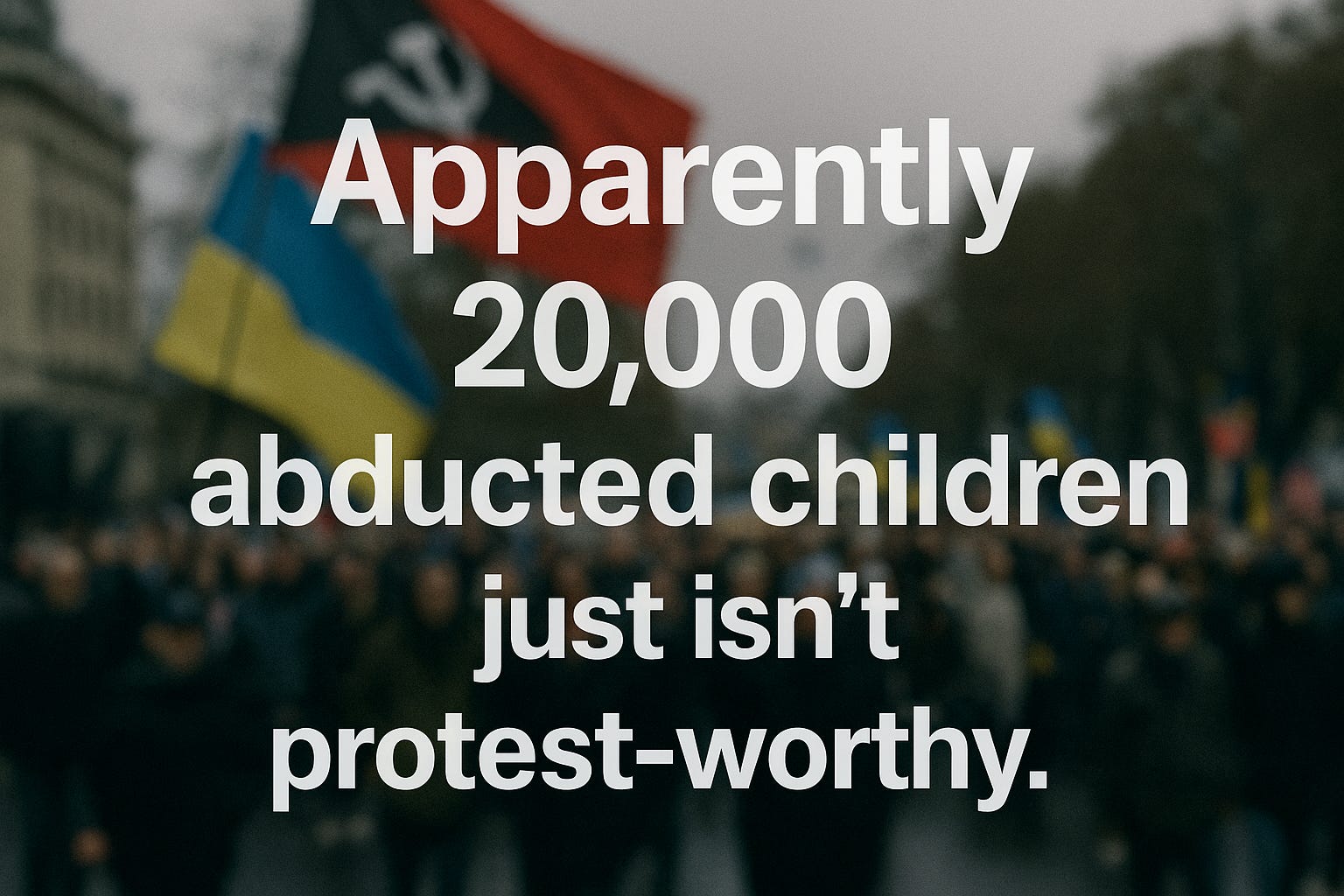
But the darkest statistic of all? Nearly 20,000 Ukrainian children have been abducted, deported into Russia, and put through “re-education” indoctrinated to forget their language, their families, their country. This isn’t speculation; it is documented, prosecuted, and has already led to arrest warrants from the International Criminal Court for Vladimir Putin himself. If ever there was a line that humanity should not allow to be crossed, it is the theft of children.
So where are the marches? Where is the Harbour Bridge covered in blue and yellow?
Why the silence?
Some of it comes down to narrative. The Israel–Palestine conflict has been framed, rightly or wrongly, as a story of coloniser and colonised. It’s simple, binary and resonates with the activist networks that have built decades of infrastructure to mobilise in Australian cities. Ukraine, by contrast, is presented as a dry matter of geopolitics: state versus state, East versus West. No room for the moral theatre that fuels a protest movement.
Some of it is fatigue. The Ukraine war has stretched into its third year. The images are less constant, the headlines more sporadic and in a distracted age, attention shifts to the fresher outrage.
Some of it is complacency. Because Australia already sides with Ukraine. Because we’ve sent aid and imposed sanctions, we tell ourselves the job is done. But outrage isn’t just about government policy — it’s about insisting that atrocities are noticed, that victims are not forgotten, and that perpetrators know the world is watching.
The consequences of selective outrage
When we ignore Ukraine, we send a message. To Russia, the message is that war crimes can be normalised, that child abductions can be survived politically. To our own societies, the message is that outrage is a performance, reserved only for conflicts that fit a fashionable script.
At home, the imbalance corrodes trust. Australians see vast crowds rally for one foreign cause, while another equally worthy, perhaps even more clear-cut in its moral stakes, is met with shrugs. That double standard divides us.
Outrage where it’s due
No one is saying the suffering in Gaza doesn’t matter. It does. But so does Ukraine. Both deserve our moral clarity, our compassion, and our voices.
If nearly 20,000 children stolen for indoctrination doesn’t move us to the streets, what will? If tens of thousands of lives extinguished in the defence of sovereignty doesn’t stir our conscience, what will?
Outrage is not a finite resource. It is not something to ration. The quiet of the world when it comes to Ukraine’s stolen children should disturb us far more than it does.
Because if we can’t summon outrage for that, perhaps the silence says more about us than it does about the war.